Inorganic Matter
A Poetry Collection by Nicolas Greenwood
Completed in March, 2026
43 poems
This is an unpublished edition.
Copyright © 2026 by Nicolas Greenwood. All rights reserved.
Za moju nastavnicu
For my teacher
Ackowledgements
Mustering the courage to write this collection would not have been possible without the encouragement and inspiration of my family, friends, and mentors.
First, I’d like to thank the City Library of Čačak for taking the time to read and promote my work. Their recognition was the first moment I felt my poetry was worthy of being presented in public, and it remains one of my greatest sources of encouragement to keep creating and sharing. I would also like to thank my friend Arakhsh Q. for his endless patience in reading and reflecting on so many of my poems, and my twin sister Anna for her unwavering support and understanding through every challenge I faced while writing this book.
I would like to thank Piero Di Biase of Formula Type for generously granting me a free license to use his beautiful font Kunst Grotesk in the printed version of this collection. Designing the book was a true pleasure because of it.
Lastly, I would like to thank my Serbian language teacher, Dr. Kristina P., to whom this collection is dedicated, for her endless encouragement and inspiration. Through her constant support and belief in each of her students, she has deeply shaped my work. Dear teacher, your love of language is contagious.
Author’s note
The title of this collection came to me suddenly one day, without warning, as I tried to think of a random set of words to use as filler text in a design project I was working on. From the moment I said it to myself, I couldn’t get it out of my head: Inorganic Matter. It sounded bold, unconventional—almost avant-garde. It felt like it was describing something new; some fresh, unusual perspective just waiting to take shape in a poem.
Months later—after many of the poems in this collection were already written—I finally understood why this cold, clinical phrase refused to leave my thoughts. It perfectly expressed the chilling lifelessness hiding behind everything I saw and touched. All at once, I realized that all matter was once inorganic, and yet it has somehow become organic—able to live, observe, think, and even love.
This realization fascinated me enough to title a collection after it. Not every poem in this book is explicitly about this transformation. But, if you take a closer look, perhaps that isn’t entirely true. Perhaps every poem ever written is, in some way, about a conscious experience of some sort. And perhaps, after reading that, you’ll see why I chose a title broad enough to hold even the most unrelated pieces together.
Allow me a short piece of advice for reading this work. Poetry collections rarely read like novels, and this is no exception. Read a poem, and close the book. There is no need to fully understand it. Sometimes, all you need is a single line that feels insightful—or at least, relatable.
Part 1: Poems
Proleće (Spring)
Part 1: Proleće from behind a window
It came one morning
When I was asleep it came
I opened my eyes to a
flood of sunlight
crystal sky
kissing breeze.
Lo, darkness had faded away
Faded away
Given way to the power of light.
Curtains slipped through my fingers
To the window was my forehead pressed
I closed my eyes
And let tears stain the glass
— the glass was cold
The sun was warm
The sun was hot.
It was golden! — it washed my face in gold
It was light
I could feel light
Power
The power of life.
Part 2: Proleće from beneath trees
She skipped through the tall grass
The hem of her white linen brushing over the blades
I followed.
The world flew past
by me
around me
through me
into me.
I heard laughter
Everything was blurry
was spinning.
I brushed my hands over those blades
Like the hem of her white linen
My steps took me onward
I was running
I was not running
I was dancing
I was not dancing
I was flying.
The trees rustled above
Rays of sunlight flickered through them
A million flashes
Through a million leaves
— I smiled
As my fingers brushed the rough bark of a trunk.
There was a scent in the air
Of something fresh
Something from long ago
That I had once forgotten
That I no longer forget
Nor remember.
We fall to the grass
watch clouds
finger buds
pick dandelions
feel our heartbeats.
Laughter again
My eyes are closed
There are hands on my shoulders
Breath in my ear.
Part 3: Proleće from along sidewalks
One by one they slide past
— they’re faces, human faces
they smile
they blink
they turn away.
‘Tis a cold wind blowing through these streets
Winding through alleyways
— an airy serpent —
It slithers around buildings
Buildings colored pastel
With marble busts agape
With marble figures adance.
Sunlight glitters on concrete
I run my fingers over graffiti stains
I stop and ponder scene
after scene
after scene.
There is a wrinkled face with the brightest eyes
There are raven locks whipped by the wind
Webs of dead branches tipped with life
Shoes stepping on crosswalks
Ashes floating in the breeze.
I walk on
The cries of children in my ears
Against the background of
That gentle cacophony of urban traffic
Knocking over
A basket of
apricots, their juice a sweet syrup
Glinting in the afternoon sun.
Part 4: Proleće from beneath stars
The starry host
They’re a great choir
One great choir
Of silence.
I could hear their singing
As we lay on the cool grass
Our arms outstretched
Embracing the sky.
All over the earth
There are whispers — thousands of whispers
The cricket’s song
The katydid’s chant
The bird’s lullaby
The mother’s goodnight.
I heard them all that night
All at once.
The world is alive
The world is born again
The world is hushed
in anticipation.
For now it is dark
And night is the time to dream
Of what will take place on the following day:
Buds will unfurl
Wings will poise and take flight
Water will dance and roar before the sun
A dragonfly’s wings will reflect a rainbow
— the story of spring will be retold
As it has
For a time longer than our lives.
Like a hand pressed against a pane of glass
So I reached for the void
Stretched above us
Spinning ever so slowly
Dancing the steady waltz of time
Too slow to perceive
Yet too swift to risk
Letting your eyes close
Before they fade away.
I reached for it
And somehow
On that strange, fragrant night
My feeble hand
Though many a light year away from their burning crowns
I knew had touched
Their eternal glow
If for only one fleeting instant.
May the immortal touch the mortal!
May the light touch the dark!
May life touch death!
May sunlight touch the frost and
May spring touch the winter.
To the Butterfly
Sunlight glowed through the orange translucence
Of her delicate wings patterned with black;
Vibrance bursted in green luminescence
Through the leaves above waving forth and back.
In delighted frenzy she fluttered on
Through a forest of light, beauty untold;
The beads of dew lit by the rays of dawn
Flew past beneath her in flashes of gold.
Her life’s a dream but a single day long
From dawn to dusk lasts her transient flight
‘Tis a life too short to understand wrong
For a soul too pure to ever see night.
In blissful ignorance her day flies past
With rapturous delight at every sight;
Every flower a beauty unsurpassed
Each moment closer to eternal night.
March, butterflies, to the grand drum of Time —
Flutter and dance while your hearts still thunder;
Plunge in that intoxication divine
Let euphoria rend you asunder.
Pause not for a moment in your pursuit
Waste not an instant of your life in thought!
Life’s a withering tree so reap its fruit
Snatch the sweetest clusters before they rot.
Flutter and dance into the jaws of death
Yes, dance as a symbol of defiance;
In beauty’s madness breathe your final breath
Embrace death in defiant compliance.
For in the futility of it all
Resides a great, unbearable beauty;
Keep your eyes fixed on the light as you fall —
Dance, oh butterfly, as is your duty!
Lily of the Valley
I run under trees through morning mist
when all is blue and the branches of trees
are shadows resembling fractals of ink.
Dew-tipped grasses rest their heads on me
and cobwebs hang in dark, sticky places
beneath arching branches bent over with leaves.
I breathe in and fly down a curved gravel road
I make my way through air thick and wet
with the green, sticky substance from which life is made.
I descend into darkness, where tree trunks and leaves
are the sun and the sky, and the dandelion seed
is alive and flies and perches on my shoulder.
The end of the trail is a sloping descent
into a valley of softness, and the feeling of dew
sprouting freshly on my cheek is a single tear wept
by the face of another, a face framed by flowers.
In a light I am bathed, a gentle white light
from a tender stem glowing, and a blossoming sun
bent sadly downwards, cupped with round petals
rains soft, silken rays illuminating the ground.
Flowers
Cast onto stone;
petals fall. Raindrops
splash down and stain.
You adorn the dead—the dead
I love—except, you too wither and
perish. I will
gather your blood rain-soaked petals
and place them in the meter of ground
between him and me. I will
find new versions of you and
adorn the dead I love
again; I will place and replace
your dying petals with new
until I too
wither and perish.
Blades of Grass
On blades of grass I lie;
they bend in the wind.
I breathe in and out,
my chest is hot and narrow;
the sky is cold and wide.
This scent of grass—
It fills my nostrils.
Grass can be torn and
grass can shred;
it can bleed a green paste
and wither in the sun.
But my cheek it tickles;
my shoulders it hugs
and caresses my neck.
It sways in the breeze, quiet;
it does not scream
nor laugh, nor weep:
it is grass.
Like dew, a cold tear
slides down; it is caught
by grass.
It does not hear.
It does not know.
It does not understand.
But tears—
it wipes away.
No time has passed.
The moment yet lives.
On blades of grass I lie;
they bend in the wind.
I Wrote This Beneath Stars
A bottle of ink spilled onto a sheet of paper
My tears fell too
It dried into a poem.
Did you know that even stars die?
I whisper to them, you are eternal!
I still do
Because all eternity means to me
is existence beyond when I cease to exist.
If only I could die before you!
So that you could become eternal
Like the stars.
I wrote this beneath stars.
A Mist Made of Stars
I am moving swiftly, and stand still
engulfed in endlessness and confined
to the distance my outstretched arms can reach;
in darkness I blindly grope
for light, and for its fiber and glow,
its warmth upon my cheek,
to see tears sparkle like glass beads
on my hands and in dreams
to bathe in its blueness once again;
eternity, and the knot of dread
grips my stomach as vastness
envelopes my body and enters
the heart beneath my ribs; I
look and drift when light, in the
shape of a single
brushstroke and as dim as a
muscae volitantes appears and
grows and
becomes a cloud, a fine mist
made from light, from flames, and from stars;
now this glow is cool and fresh and
mysterious, like a spirit, and clearing
my vision, washing it from darkness; coldness
it is, and lifeless—solitary, and as merciful
as that cabin that shelters
the winter traveller; there are webs
of light moving past, clusters of light, almost organic
in shape and form, and dust
glows like clouds in a photograph
of undeveloped film; suddenly
this mist becomes discernible and
particles emerge from regularity; they are
specks of light with jagged edges—an
infinity-pointed star; they blur into eye water and
burn my vision when my eyelids close;
they form streaks,
and streaks form circles and spirals
and, like comets, their trail burns
out slowly behind them with decreasing intensity;
I look,
I close my eyes, and I cannot escape
their fire; I cannot turn away
from these visions and
these flashes no matter
how quickly I turn my head; my jaw clenches and
my tongue is bitter inside my mouth; I refuse to breathe
until this light fades away, until these flames
cease to lick at my cornea, when
suddenly blackness, inky and merciful
coats my eyes, and in oblivion
I find rest; this blackness is so perfectly black
that it is almost brown; solid, and so vast and empty
that when I reach out, there is nothing to touch;
I feel small—
small and warm again; my head does not hurt
nor does light burn me; I do not feel
my heart beneath my ribs nor does
blue coldness tell me I am dreaming and there is
no bitterness and
no sweetness either but there is only
everything and
nothing.
Sleepless
In a park, on a bench, lying down,
the back is numb and the head
Is impossible to move.
It is then
that the sky above becomes the sky beneath,
inducing a sudden sense of vertigo.
It is then
that the ground above me pulls me to itself,
keeping me from falling into the starry abyss below.
It is then
that concrete reaches up towards heaven
leaning over me and hiding the moon from view.
It is then
that shadows on the street do play
laughing and dancing ’til the morning light.
In a park, on a bench, lying down,
the back is numb and the head
Is impossible to move.
It is then
that I am
sleepless.
Gravity
Crimson red were the leaves and
wet were the lands and streets. Faulty
were the eyes that beheld your beauty
and empty were the arms that embraced you.
And even though wind in my ear whispers and
silver clouds above do quiver in my teardrops,
your touch remained forever just beyond my reach.
I confess, nights did pass
with sleeplessness; I burned candles, and flames
did blind my eyes. Creases in fabric became
my meditation, and light—the kind not seen, but felt;
white and pure,
Impossible and unbearable—
did pierce my closed, dreaming eyes. And yet,
your face, so unforgettable,
was impossible to remember.
I confess, into a field I went
into a meadow I wandered and
into a sky I looked.
I confess, my head I threw back
and of flying I dreamed.
Among clouds and birds I wished to be
the earth below I longed to see
further and further away from me—
but it was not to be.
And yet though all this the clock did tick;
the sun did move and its zenith cross
and into the sky I did not ascend
nor could your face remember.
Cold air I did breathe and water colder
did I taste; clouds and dust
and leaves and ceilings
did hide your face from view. Birds
I watched ascend; their eyes I saw
moist and pearly from venturing so near
the sun and on mountains tall
I gazed and wept, whose peaks, so close to heaven,
were swept with wind, and where ice
did crack and crumble; in the gusts
I hoped for salvation; of riding their wings I dreamed;
to be carried in their arms I longed.
Gravity it was to blame; I could feel him in each
and every step, and when I slept, his weight
did slowly bend and distort my limbs; his pressure
did squeeze and crack my temples and lower
my line of sight to the ground. The sky,
for which I reached and opened my chest,
he pulled me from and to my ankles
clung; from up there, in the endless blue
he held me, and from my sight of you.
Among clouds and birds I wished to be
the earth below I longed to see
further and further away from me—
but it was not to be.
To the Eagle
flying at so great a height -
that to my eyes you’re but a sliver
fading into endless blue; —
in my dreams I fly your flight -
and turn the clouds into ground below me
—a ground the wind had raised me through.
When I close my eyes, this land I see:
an empty place, by hands untouched;
of wind, and mist, and sun rays bright.
And a strange, glistening eternity
with wings outstretched in flight with you
does blind my feeble, mortal sight.
Asking for Love
He is afraid
to ask for love.
Because
he might be embarrassed
or she might think him strange.
Because
certainly so many have asked her before
and over time she has come
to dread and despise it.
Because
it embarrasses her,
and she does not feel pleasant.
Because
she might have to say no, and that is not
what the asker or anyone likes to hear.
One day he asks her, because he simply can’t bear
to see her and watch her and not find out what
could possibly happen
if he did such a thing.
He asks for something
that she will not give.
She tells him no,
but he persists.
She becomes angry and
he only laughs.
She becomes more angry, and
he takes offense.
He becomes angry too, and
she takes offense.
They are both very angry, and
they both take offense.
They both storm off in a
frightful rage.
They both feel guilt
a while later that day
and a tinge of disbelief that
such awful things
could be uttered by their own and the other’s mouth.
They both, for a day, and
a week, and
a month,
avoid each other’s glances and
stiffly ignore
the very existence of
the other one’s person.
Until, one day, in the sunshine of May
the face once ignored
appears more beautiful than
what was remembered,
and the burning in
their chest had now vanished.
Words not said
became words gently said and
hands not held
became hands gently held and
lips not kissed
became lips gently kissed and
he was not afraid
to ask for love.
The Blue
What are those filaments gliding in the wind?
For a moment flashing a rainbow, flying up higher
and higher until the sun’s angle changes and it becomes one with the blue.
I say, the faded yellow paint never looked clearer against
it.
There is a reflection of it in the blackness of your eyes.
I am tired, and tearful with joy
at the wide, open sky and the hand in my hand.
Dreaming of You
Moths dance in the streetlight as
You lean on my shoulder. Shadows play
On a brick wall and
We are silent.
We do not think, but watch
Moonlit leaves wave
And listen to the hum of night
Against the foreground of each other’s breathing.
And though the clouds have covered
The stars I know from view
Though the words you whispered
Are no longer true
I still say them to myself
And dream the voice is you
And dream the voice is you.
We are standing on a bridge
The sunlight is white and strange
Your face is marble and stone
Marble and stone—and the wind
Blows through us as we stand
From a great height over a river
I once dropped a ring into
A ring for you.
And though a hand has covered
The eyes I know from view
Though the words I whispered
Are no longer true
I still say them to myself
And dream I speak to you
And dream I speak to you.
You Remind Me
You remind me of a time
When I smiled with tears on my cheeks
When you graced me with your presence
When I dipped my fingers into the stream.
You remind me of a place
Where the wind was cool
Where it blew your hair
And covered your eyes.
You remind me of the day
I gazed at the clouds
My back to the earth
And saw your face in them.
Faces
On thirsty ground our footsteps fall
Through barren sand our fingers trace
Faces with untempered grace
Untouched by the impossible.
A thousand times the words we’ve said
Do we mean them is the question
Do words come before connection?
To love conceive must we pretend?
Or are our hearts set on fire
On their own; can a flame ignite
Without a spark; do souls unite
Truly by their own desire?
Absence
For some reason I do not know
Your hand slipped away from my own
It slipped away without a word
In silence, I was left alone.
I asked the stars to tell me why
From a life your presence had graced
You faded away so softly
To a city so distant placed;
They replied not a word at all
I was left flying through their light
On a field wet with starlit dew
In a dream with no end in sight.
My tears fell into a river
It carried them down to the sea
There in that tomb of mankind’s tears
To billow for eternity.
Then in the wind I heard your voice
Not a word — alas — just a moan
A sweet-breathed whisper on my face
Though the night from a land unknown.
I felt your touch in the cold gusts
Your presence borne upon its wings
Filling my chest with shards of you
A sculpture made of broken things.
I embraced that sweet empty place
A spirit made of thoughts of you
For one short night, before the time
To vanish, once again, was due.
I See Faces I Will Not See Again
I see faces I will not see again
faces cold and empty, faces made of stone
and smiles, and a deep, hidden scar
flashing in tender, grief-stricken eyes.
I see faces I will not see again
and these faces I dream of, but can never remember;
I see outlines and smudges of crimson and pink
and the dark shadows of coats crossing the street.
Three Thoughts While Riding a Bus
Thought 1
The bar is round
But it does not feel round in my hand.
The bar must be round
But it feels like an elliptical cylinder.
This is a game of motion and momentum;
There is a window, a bar and a shifting floor
Which you must use to stand and not fall.
And through this window there is a sight
From which you will not be able to tear your eyes
For the world siding past through an aperture
Is another from the one standing still, surrounding.
Thought 2
This face holds a specific position
Like a mask, when the head moves, it follows, motionless.
This face glows a specific hue
Like a mask, there are no eyes, but dark hollows.
Silently, it leans gently on glass
Bathed in sunlight, beautiful and
artificial, like an overblown, high contrast photograph.
It is not a face, but a sun—
So it seems, as my eyes slowly close
—it is a star, with rays of its own
And warmth; fiery, life-giving, impossible to behold.
Thought 3
Swept over wet pavement, the wind
blowing through the window ajar, is cool and fresh.
Cutting like ice over tear-moistened eyes
Touching strands of hair, it caresses.
I know this wind; my planet
Has made a revolution and a little more since I last felt
Its tresses smother my respiration.
It is the very same air that rushed through my lungs
When sweet weight fell onto me and cold water
Dripped from my fingers and glittered in the sun.
I step out into this air, with the sun shining on me.
Streetlight
In silence it glows
In her hand a rose
From her gaze she knows
We shall glimpse no more the sun.
In darkness complete
In bitterness sweet
Our tears on concrete
We listen to the echo of our own laughter.
That was long ago
Before the sun’s glow
Left the skies we know
And left us alone in streetlight.
Your hands touch my face
A tear to erase
Your finger’s soft trace
Draws a line through a coat of ashes.
Hear the glow of night
See the frozen light
Of a silv’ry white
Moon that listens to our smallest whispers.
In our arms to die
Beneath a dark sky
Is our destiny
So it seems, so it shall be.
So to my eyes raise
Your heartbroken gaze
To see through the haze
Of a fading streetlight that you wither not in solitude.
Smoking
Leaning on a wall
laughing hoarsely
eyes bleary and
half-closed from smiling
—or is it a smirk?
Ashes float down.
He doesn’t have a mother
he must go to sleep
alone in his room
with the door closed
as the television echoes
from another room.
Vreme (Time)
Original (Serbian)
Surovo je to vreme jer
kad padne mrak, taj dan ne može da se vrati.
Kad padaju suze — one su pale, zauvek.
Jer krv, kad se proli, više ne ostaje u telu.
Jer sećanja ne mogu biti ista kao stvarnost.
Surovo je to vreme.
Surovo je to vreme jer
gde je smrt prošla, život ne prati.
Jer je prošlost nešto što ne postoji.
A ono što vidimo — nestane i nestane!
Svaki trenutak je prolazni trenutak.
Surovo je to vreme.
Milo je to vreme jer
kad duva vetar — duva u naletima.
Jer u istom danu sunce sija s obe strane neba.
Jer nam daje kraj pre nego što
život postane predug i gorak.
Milo je to vreme.
Milo je to vreme jer
ni dobro ni zlo ne postaju večni.
Jer suze, kada padnu, padnu — i presuše.
A vreme daje lepoti njenu krunu,
jer lepota, kad je prolazna, biva još lepša.
Milo je to vreme.
English Translation
Cruel is time because
When darkness falls, that day cannot return
When tears fall, they are fallen forever
Because blood, when spilled, remains not in the body
Because memories are not the same as reality
Cruel is time.
Cruel is time because
Where death has passed, life does not follow
Because the past is something that doesn’t exist
And everything we see — vanishes and vanishes!1
Every moment is a passing moment
Cruel is time.
Merciful is time because
When wind blows, it blows in gusts.
Because in the same day the sun shines on both sides of
the sky.
Because it gives us an end before
Life becomes long and bitter.
Merciful is time.
Merciful is time because
neither good nor evil become eternal.
Because tears, when they fall, fall — and dry up.
And time gives beauty her crown,
because beauty, when fleeting, is only more beautiful.
Merciful is time.
Horizon
To the aisles we turn our bow
To the distance we point our gaze
Through foreign seas our boat we row
To drifting winds our sails we raise.
By fading stars we chart our way
With feeble hands our wheel we spin
B’neath stormy skies our prayers we say
With silent tears our days begin.
Our eyes we fix on that line
The only shore we’ll never beach
A place where sea and sky combine
Forever there, just out of reach.
Another Day Ended
Another day ended, and I have not seen
nor will see such things as I have today;
the sunset is faded and I have not been
myself or another on this transient day.
Another day ended, and I have not walked
on my long, dusty path. Rain has not fallen,
nor footprints been made in soft, sandy waters;
another day ended and no trace will there be
of today, or tomorrow, or eternity.
Another ended and I have not died
nor fallen in love, nor seen a man’s face
I will longer remember than this even’s final thought;
I have not completed the song on my table
nor closed my eyes in prayer and it’s another day ended.
Another day ended and I have not lost
a someone I love, and I have not cried
for a reason or simply no reason at all;
I have not forgiven, nor danced to a song
long gone and forgotten and once again, it’s
Another day ended. Bright stars gently shine—
shine close and distant at the very same time.
the moon’s place is vacant and I have not been
myself or another on this transient day.
Dear Yellow,
“Dear yellow, you haunt me. You
bleed and shock
allure and soothe
pierce and cut
crack and fade.”
You’re everywhere
I see you through the trees,
In sunlight, beneath my cheek;
You burn my eyes until
All I see is you
until I am yellow.
“Dear yellow, why so pale? Do you
also age and weaken?
Will you also die one day?
These chips of you crumbling
between my fingers—are these your
cremated remains?”
You’re everywhere
I see you passing by,
In the sky, on the walls;
You burn my eyes until
All I see is you
until I am yellow.
“Dear yellow, I apologize. You are sweet,
and sour too; these hands, you see,
are also turning yellow, and these eyes,
when I turn them left and right
are yellow. So, you see
that I too am yellow,
and will age and weaken,
and you will one day
crumble my cremated remains
between your fingers.”
You’re everywhere
I see you in the mirror,
In the fire, on my skin;
You burn my eyes until
All I see is you
until I am yellow.
Truly, It Comes As No Surprise
Truly, it comes as no surprise
to see you again with your
enflamed face and bloodied eyes
and your harsh, unending, hellish cries.
I say, I’ve known this face before
from beneath sleepless eyelids sore
from tears and terror-stricken nights
and clouded skies and blinding lights
and subtle knocking at my door.
Truly, it comes as no surprise
to hear you again, as within
my own heart sinks and organs rise
to fill my mouth with blood and lies
I swallow before your very eyes.
Like an old friend you stop by
of bygone days to reflect and query why
my brow is fresh and eyelids dry
my hands are clean and dreams are sweet
and how dare I hold my head so high!
Like a tender father you bend the knee
stroke my cheek and ask of me
how I could’ve strayed from the
only way you’ve taught to me
and ventured past the gate to see
from beyond the hills the sunlight rise
and dry this pair of tear-stained eyes
—no, indeed, your thought of me
—truly, it comes as no surprise.
To Pain I Say
To pain I say, thank you
because the day, for once, seems longer
and the hands on the clock stand still,
straining, twitching, convulsing
against their will.
To pain I whisper, thank you
because your arms grip tighter
than anyone else I know
and you never, ever, ever
let me go.
Walk
…through the wind.
Cracked
and broken walls will slide past and
the brilliance of the sun will burn
the tears that spill down your face.
Breathe
and brush your cheek against these crumbling walls;
turn your eyes
to the ground and watch
this body and these limbs
living and moving and
reappearing again.
Walk
and live, and place one foot
after another.
…through darkness and light.
You will feel
your heart beating in your chest, and
life pulsing through your veins. One day
the ground will embrace you, and your eyes will sink
into dust, away from the wind and the
brilliance of the sun.
Walk
and live, and place on foot
after another, through the wind.
He Watches Me
He watches me, and the steps I take.
With eyeglasses on, his head unmoving,
and his otherworldly, quiet, expressionless face,
looking intently without judgement or grace,
he watches me, and the steps I take.
He watches me, and the choices I make.
Seated on a chair, a pen in his hand,
he writes and then pauses and then scribbles again,
his eyes never moving or leaving me when
he watches me, and the choices I make.
He watches me, and the promises I break.
Silently, he folds a piece of paper and,
opening a drawer, places it within.
His eyes are unblinking and perfectly thin.
He watches me, and the promises I break.
To Styx
Dear Styx,
you are my ever-present, awful
and loveliest solace. My dreams of bathing
in your gray, leaden waters are sweet
—only the leap frightens me more
than the uncertainty of living tomorrow.
Because your water is opaque
and thick, molten metal;
and because from the place
beneath your waters no eye can see
I dream of immersion
below your waves.
Because your current is quiet
and never disturbs,
and your temperature colder
than I can feel on my skin
I gaze, undecided
on the rail of the bridge.
Styx, you tempt me
but more than this, you vex me
with that slow, quiet lapping
of your syrupy waves on the skulls of men.
And Styx, my friend, you tell me
in that sweet and rich but nauseating voice
promises I know you cannot keep.
With wind in my face I reel from the railing
—this wind that’s blowing blows me away
from your waters, dear Styx, so adieu, my friend!
The earth has spoken and demands me to stay.
I Will Read Myself a Poem
I will read myself a poem
in the darkness, in the night;
I will burn a candle to light these pages
until the letters burn and curl away.
In the rain I will shelter
this book under my coat,
and bend over and with my finger
trace lines breathing comfort
and fire, and sweet absurdity
from the hot, hollow darkness
between my chest and my lapel.
I will read myself a poem
on the sand, by the water.
I will let the wind turn my pages
and the waves whisper verses;
I will let the sun burn my forehead
and I will not look up
until I’m blinded by the whiteness
of paper scorching in the sun.
I will read myself a poem
in the morning, when the sky
glows fresh and silver, and my eyes are bleary
with sleep, and the faces in my dreams
still linger in my thoughts;
I will watch the sun rising
through a sheet of ink and paper
and read myself a poem
until the break of day.
That Thing
When you met That Thing, it was love at first sight. There’s no better feeling than thinking about it, admiring it, loving it. Why, the very dreams of life were That Thing! You embraced it, it embraced you back, and you felt like one. And then, something happens. It always does. It’s called Time. It passes. It always does. You cannot focus and love one thing all the time, for a long time. And then, one day, you revisited That Thing, and it’s gone. It’s left. It’s not there anymore, and the only thing that remained was its shadow and maybe a lingering outline in the air.
And then, one day, you meet That Thing. You meet it on the road, unexpectedly, and you’re overjoyed. You say hello but shake their hand instead of embracing them. And then, you realize that their clothes have changed, and they smell different. Their hairstyle has changed too. But most importantly, they hardly recognize you. They’ve forgotten you. And you laugh and remind them of the fun things you’ve done together, and they laugh too, hollowly, and with a tinge of confusion on their face.
And then, you move on the road. You pick up your pace. Somehow, the feeling of meeting them is worse than if you’d never met them at all. How unexpectedly expected. You are sick, and your spit is bitter in your mouth. You walk and breathe, and the sky and the road spin around and around you. You love this thing, and you loathe this thing. You stumble on, step after step, and you want to sleep.
Then you find a tree—a thick, beautiful, ancient tree. Its bark is smooth and its leaves are lush and green. You touch this tree, lean on this tree, sit by this tree. You love this tree. Somehow, this tree consoles you. In its cool shade, you’re sheltered from the dusty, sunburnt road and bitter spit. And the rustling of its branches in the wind is so spontaneous and oblivious to the world that you too feel spontaneous and oblivious to the world. You fall asleep. And you forget That Thing.
Bipolar
To the cracks on the sidewalk I say, “I’m tired.”
Fine grains of sand in the asphalt mix
flash sharply in my softened vision
and birds are singing
in a peaceful place.
Birds are singing under the shade of leaves;
branches clothed in golden bark
surround and embrace them from every side.
Last night, in the dark, there were arms around me
and coldness did stream from my forehead’s surface
I dared not move, but inhaled the scent
of myself, and the uncanny coolness of night.
And the scent I encountered on another cool day
by a white, pounding fountain in the crispness of autumn
was carried by the wind and brought to my mind
bright colors and bubbles and a childhood dream.
Laughing, screaming faces and the grip of a hand
on my bare, swinging ankles are a childhood dream;
fine grains of sand in the asphalt mix
flash sharply in my softened vision.
To the cracks on the sidewalk I say, “I’m tired.”
Into the Tomb We Go
With gentle footsteps and cold wind
biting the tips of our tear-stained fingers
under a sky darker than midnight
and our every heartbeat haunted
by the shadow our bodies leave behind
in the cave, in the lanternlight
and with the dread of the existing
beholding the nonexisting and the
awful delight we take in the glittering stone
of the cave wall, shaped like a massive, laughing skull
and with the torches we grip in perspiring hands
above the coffin, polished wood reflecting orange
and the cold, dry, lifeless air
we fill our lungs so cautiously with
into the tomb we go.
That air, so clear, so blue
floating above the sand
—a sand that has never seen rain
a sand fine and motionless
a sand soon to swallow a man’s bones—
that air, we fear
As pure and as undefiled as moondust
still and thick
cold, cruel, merciless!
A peaceful mantle for the dead.
Wading through this air
swimming, breathing it, suffocating on it!
—into the tomb we go.
And there,
in that shallow hollow scratched out in the ground
a box descends
a box with man (or is it a man any longer?)
wrapped in cloth
his eyes closed, his limbs distorted
a body, a vessel of thought,
of pain,
of hot breath
of a lifetime of memory
of hands that felt
of eyes that see
now to fall back
into the ground, into a scratched out hollow
gaping like a soft, earthen mouth
to slip between lips of sand
for those lips to close
for those hands and
eyes and
all that ever was this man
to fade and crumble and melt and dissolve!
To become one with that sand
And that bitter, sterile air—
out of the tomb we go.
And out into that frigid air
wet and rotten
consoling and alive
we walk, we scatter
under clouds and sun and a million birds
quiet or not
laughing or distraught
left and right, up and down
and through the country and the town
forgetting and remembering and then choosing to forget
the gaping mouth and those lips of sand
and that lifeless cave and ghostly air
and that they and I and even her—
into the tomb we go.
To the Depths of the Ionian Sea
In memoriam, Vladislav Petković Dis
(1880-1917)
We sink, for the shore’s too far to see
We fall from a dark and ominous sky
To the depths of the Ionian Sea.
From the deep we pulled up our anchors three
With bleeding hands we raised our colors high
We sink, for the shore’s too far to see.
We dream of nothing but eternity
We descend to a place where great men lie
To the depths of the Ionian Sea.
Lo, our hearts yet beat, our eyes yet see!
Oh hollow deep! Drown not our cry!
We sink, for the shore’s too far to see.
O’er life Fate has chosen serenity
To eternal rest like birds we fly
To the depths of the Ionian Sea.
To our tombs ordained by Deity
Below the waves’ unceasing lullaby
We sink, for the shore’s too far to see
To the depths of the Ionian Sea.
Dear Pacific,
You covered my face with freshness
‘Twas inside the roar I felt your balm
Of foaming brine washed ashore
With celestial reflection from the sky
Dancing below me in silvery grey.
I watched your waves leap at the clouds
Beneath the surface a depth untold
You hid with an ominous mantle
Of shimmer bright and waves hypnotic
A forgotten tale below the light of day.
Beneath your ripples of molten lead
I glimpsed a world of iridescent blue
A place where tears are never shed
That fades into darkness’s oblivion
Like the sky’s night that fades away.
I saw palm trees bent in the wind
A wind that made the grains of sand dance
Lo, the sky wept; I saw her tears fall
The rain lent tears to my windswept cheeks
Your angry waves swirled into the bay.
Then, like a dream, it was all gone
The moonlight reflected off your ripples
You whispered something I couldn’t understand
Something about love, something about hate
Something about a face that slipped away.
Ah, tell me, mysterious waves
The secrets you hold beneath your foam
The sights you saw, the ages that passed you
Tell me a story of your origins
Of the times before night and day.
Did you freeze into an icy stone
When you traversed the cosmic hall
Glittering with the light of stars
All to one day wash these humble shores
And splash these cliffs with glorious spray?
And what of tomorrow, dear ocean
Whither lies your next destination?
What alien sky will you reflect?
What foreign shores will you carve and sculpt
Oh beautiful ocean, so blue, so grey?
I understand it now; I hear your voice;
The answer lies in that strange place
Where the stars and your surface meet
Called the horizon by a few of us
Where begins and ends night and day.
From Dust
You are
formed from a gust of wind
swirled into a pillar and bended
into your shape; you are
a moving thing of nature
now frozen
now burning in the crook of my elbow—
always present,
like a steady breeze; your face
and the skin beneath my fingers
are
from dust.
You are
particles, and a ghost;
emptiness, and the weight on my chest;
you block the sun on my right-hand side
and wipe strands of hair
from my sweat-soaked forehead; you are
rays of light and threads of silk; you are
the scent on my pillow and the
blood between my teeth; you are
alive and somehow made
from dust.
And you are
dust cherished by dust;
these eyes that behold you
dream of you in sleep.
Quiet though our footsteps be,
they echo, faintly, to eternity;
we dissolve, but not apart;
swept by the wind, into a mist
from dust.
Bread
I look down at
bread in a golden bowl,
the flesh of man (or is it the Flesh of God?)
the scent warm and biting
and slightly intoxicating.
I watch wine soak this bread
drench it, drown it
like a wound fountaining
the blood of man (or is it the Blood of God?)
until the bottle empties
and the blood dries out.
I chew bread slowly
as a man’s eyes on the wall behold me
(or are they the Eyes of God?)
and inhale the sharpness
of burning frankincense.
Hunger
Hunger and
hollowness in their eyes haunt my dreams;
I see withered hands clutching bowls made of stainless
steel.
On the ground they slump;
sun and sweat glisten on their faces
(or is it tears?); fingers
are all I see—a thousand twitching, grasping fingers and
grimaces and
dark shadows concealing
living, bitter eyes.
Tent flaps snap fiercely in the wind.
On this face, there is blood escaping the corners of his lips
and
over there are distorted arms half-buried in dust.
The cacophonous clang of ladles grating empty pots
is a lullaby
to the throbbing head on the sand.
Welcome, Little One
Dear Little One,
It is with pleasure that we welcome you to this world. There will be many things you will not understand, but you can trust us to provide you with answers. Over time, you will learn to be productive and happy. We look forward to a long life of cooperation and contribution.
Best wishes,
[blank]
Welcome, Little One.
This air you will breathe
These hands you will trust
This name will be yours.
Wear these clothes you must.
This book you will learn
These lines you must say
This path you must take
These words will you pray.
This face you will love
This name you must hate
This work will you do
You must never be late.
In this place you will be
For this flag you must die
This blood you must shed.
In this grave you will lie.
“Greetings, sir.”
“Greetings, sir. I have a question.”
“Go ahead.”
“Greetings, sir. What is your name?”
“My na—”
“Greetings, sir. We wish you a wonderful day.”
“But I thought—”
“Greetings, sir.”
A tear falls, but wind blows it away.
“Greetings, sir. We love you.”
“Thank you. I love you too.”
“Greetings, sir. What did you say?”
“I told you I lo—”
“Greetings, sir. Our answer is no.”
“But I didn’t ask anything. I just—”
“Greetings, sir.”
A heart breaks, but the pieces are glued together.
“Greetings, sir. You need help.”
“I know. Thank you.”
“Greetings, sir. Take a deep breath.”
“I did. I feel better.”
“Greetings, sir. Step aside to let others have their turn.”
“Just one moment—”
“Greetings, sir.”
Someone stumbles, but no one looks.
“Greetings, sir. We congratulate you.”
“I appreciate it. What for?”
“Greetings, sir. What do you mean?”
“You congratulated me for somethi—”
“Greetings, sir. Please cooperate.”
“I am cooperati—”
“Greetings, sir.”
Words are spoken, but silence swallows them up.
“Greetings, sir. How can we help?”
“I’m a little tired. I need to rest.”
“Greetings, sir. Are you complaining?”
“I’m sorry, I—”
“Greetings, sir. Your time is up.”
“That can’t be! I just—”
“Greetings, sir.”
Years pass, but nothing changes.
“Greetings, sir. Thank you for your service.”
“It was an honor. I am—”
“Greetings, sir. Please move aside.”
“Of course, I don’t wish to—”
“Greetings, sir. Again, thank you for your service.”
“But what is this? Am I being—”
“Greetings, sir.”
There is screaming, but oblivion beckons.
Everyone Dies, but You Are Not Everyone
Everyone dies, but
you are not everyone.
You are someone.
And when you feel drowsy,
you must not succumb to sleep,
but struggle—do you hear me? Struggle!—and
flood your vision with daylight.
Everyone dies, but
you are not everyone.
You are someone.
And when you feel weak,
you must not let your muscles relax,
but tense them—do you hear me? Tense them!—and
clench your teeth tightly together.
Everyone dies, but
you are not everyone.
You are someone.
And when your heartbeats begin to falter,
you must not lose breath,
but fill your lungs with air—do you hear me? Fill your lungs
with air!—and
fix your eyes on the sky.
Everyone dies, but
you are not everyone.
You are someone.
And when darkness appears around the corners of your
vision
you must not let go,
but look into my eyes—do you hear me? Look into my
eyes!—and
chase the darkness away.
Lines
(In a whisper)
There are lines;
lines curving
lines unbroken
—there are lines on your face.
One morning I awoke
And your hair was a shadow in a window.
Bitterness was on my tongue and dryness
in my throat.
It’s on days like these that linen
wraps around you and hugs
your shoulders;
it’s on days like these that,
when I love you, I cannot breathe.
Through your skin I cannot cross;
it stretches over your bones and
when you laugh, I see death. Forget
that years pass, forget
that your blood isn’t hot
any longer.
(In a whisper)
There are lines;
lines curving
lines unbroken
—there are lines on your face.
Another morning I awoke
And your hair was a shadow in a dream.
You smile, and your face bends
with hollowness in your cheeks and
darkness in the creases
by your eyes; powder glitters
on your forehead; these hands will I kiss
—these thin, pallid hands—your corpse
will I embrace, will I cherish;
in your grave will I weep on your shoulder.
(In a whisper)
There are lines;
lines curving
lines unbroken
—there are lines on your face.
And another morning I awoke
And your hair was a shadow blocking the sun.
I was afraid this would happen,
that, one day, darkness would come.
You walk, and your woolen collar clings to your neck;
Your eyes fade; only sparks remain.
One day you will turn to me
and it will not be you who turns to me.
One day lines will prevail
and in my shoulder will I hide them.
One day we will be cold
and the warmth of summer will seem
like nothing more than a distant dream.
(In a whisper)
There are lines;
lines curving
lines unbroken
—there are lines on your face.
Inorganic Matter
A scent of grass in the air!
Quietness, and a steady breeze
the ring of a bicycle and a man’s shout
from another one’s place and another one’s life.
The head leans against a window and ponders life
and the existence of itself, and this pane of glass
preventing it from falling, and a woman’s grasp
cold skin and the rushing of blood.
In us there is the animal, the vital, the unaware;
the sunlit neck moistened with sweat and unrestrained dream;
the thin black eyebrow and the fiery eye
and the delirium of conscious sleep.
Your face escapes me, and I see nothing but
the rims of eyelids, up close, in the sun
and your gentle voice calling me in the darkness of night
echoing away until I open my eyes.
My memory is the stone, and your face is the fossil;
I see atoms in your eyes, and your very own skin
has suddenly hardened, and lost its life,
and heat, and touch, and radiance.
You are bliss, and immortal; unconscious, like nature.
Chemistry, and the bitter salt in my tears.
A rearrangement of atoms so sweet, so lovely;
you are breath and life, and inorganic matter.
Part 2: Notes
A Note on Proleće (Spring)
Proleće is the result of months of observing springtime here in Serbia. When I moved to this country a few years ago and experienced a Serbian spring for the first time, I was overwhelmed with how lush, green, sunny, and dreamy it felt. The air had a kind ofunique floral scent I’d never inhaled before and the general atmosphere was hopeful in a completely new and beautiful way.
Less than a kilometer from where I lived, there was a long path winding beside a river through fields and patches of forest. It was this place that inspired much of this poem. I would walk here almost every day, taking in the powerful lushness of Serbian spring.
A few months after writing Proleće, I had the privilege of being able to present both an English and a translated Serbian version of the last part of the poem, Proleće From Beneath Stars, to a live audience during an event hosted by the City Library of Čačak, where I also worked as a volunteer for several months.
A Note on To the Butterfly
This poem was also inspired by my long riverside walks. The area was rich with wildlife and I remember thinking as I watched butterflies flutter across the path about their short, beautiful little existences.
I was also inspired by Serbian author Desanka Maksimović’s brilliant work Bajka o Kratkovečnoj, a children’s story following a butterfly with a very short lifespan.
A Note on Lily of the Valley
There is something inexplicably magical about walking in a forest early in the morning, before the sun rises. The grass and flowers are wet with dew and all of our familiar places somehow look dramatically different. Flowers begin to open and light itself feels strangely dim and precious.
A Note on Flowers
One of the saddest things I have ever seen is a gravestone with old, wilted flowers from months, if not years ago.
“So long as we are being remembered, we remain alive.”
Carlos Ruiz Zafón, The Shadow of the Wind
A Note on Blades of Grass
Grass is uniquely poetic. Like stars, it simply exists, whether we notice it or not. This poem was partly inspired by Walt Whitman’s poem Song of Myself, 6 [A child said, What is the grass?], part of his collection Leaves of Grass, which is also widely considered one of the greatest pieces of American poetry ever written.
A Note on I Wrote This Beneath Stars
I did indeed physically write this poem beneath a starry sky, but the true significance of this piece lies in the realization that eternity, as illogical as it sounds, is very much a subjective concept. Eternity is only as large as you can imagine it to be.
A Note on A Mist Made of Stars
The title of the poem came to me suddenly, as I took a quick glance up at the night sky before entering a doorway. The initial idea was to convey the massive scale of galaxies and groups of stars by using the term “mist” to describe their quantity. As I wrote, however, the poem took more of a philosophical turn. It asks the question, how safe are we in our ignorance? How much light are we ready to take?
A Note on Sleepless
It has always struck me as unbelievable and tragic that so many of us, in the second quarter of the 21st century, still spend their nights on benches. I have always wondered, what is it like to fall asleep night after night under an open sky? The nights must feel unbearably long and strangely peaceful.
A Note on Gravity
Gravity, like circumstance, holds us down so constantly that we are hardly aware of it. And yet, sometimes I suddenly feel it. I feel dizzy and notice its pressure on my head and body ever pulling me downwards. Limitation is one way to distinguish between dreams and reality.
A Note on To the Eagle
This poem is very much an extension of the previous. The words came to me all at once as I watched a bird in flight so high above me that it was nothing but a sliver barely visible in the blue.
A Note on Asking for Love
This poem unexpectedly came to be as I was writing out the structure of a poem. Somehow, I found the unusual, rigid style peculiarly charming, and I decided to complete the poem in the same style.
In this modern world of internet and fast-paced lifestyles, loneliness and lack of human connection are things I hear people complain about all the time. And they aren’t wrong to do so. Relationships of many kinds are essential for mental health and well-being. Unfortunately, it is becoming increasingly harder to make new connections when so many of us spend most of our free time alone in front of a screen or doing other solitary activities.
This poem suggests a simple solution: just ask. Take the step—don’t be afraid! Approach that person you like and don’t take whatever they might say too personally. They too are a person just like you, with just the same doubts and fears. Love them, respect them, and let time do its work.
A Note on The Blue
There is this euphoric, carefree feeling I sometimes get when I’m walking outside somewhere under a clear blue sky. Somehow, my vision feels clearer and everything seems more beautiful than I remember it. This is a poem about that feeling.
A Note on Dreaming of You
In my city there is a large, white bridge stretching over the Danube. I remember gazing at it and feeling the warm, heady, and slightly sickening sensation of missing someone on a bright, dusty August day—very similar to the rush of vertigo that comes when we lean over the railing of a bridge and gaze at the water below.
A Note on You Remind Me
This is a piece on déjà vu—but only the delightful kind.
A Note on Faces
This question has always intrigued me: do we meet people we love, or do we love people we meet? Whatever the answer, I think both realities are equally beautiful.
A Note on Absence
This is a tribute to all those I’ve had to leave behind as well as a reflection on the nature of memory and how memories, no matter how beautiful or vivid, can never replace seeing those we love and think of the most in real life.
A Note on I See Faces I Will Not See Again
Strangers leave a deeper impression on me than I often admit. Sometimes I can recall a completely random face I only ever saw once for years afterwards. I’ve always wondered about the explanation for this. This poem describes this experience, and not without a tinge of melancholy.
A Note on Three Thoughts While Riding a Bus
Riding buses was something I hadn’t done very much prior to moving to Europe, and to this day it remains a memorable experience every time I do it.
Being in such close proximity to so many unknown people is certainly one reason for that. As someone who observes others perhaps a little too much, every trip to town on board a bus invariably turns into a deep psychological and philosophical reverie.
This poem doesn’t try to do anything more than describe a few glimpses of my thought process when I’m on board.
A Note on Streetlight
Like many of my poems, Streetlight was inspired by one of my long walks. I would walk through my city after sunset, when the streets were largely empty and there was nothing but dim, silent light glowing from streetlamps down on the sidewalk.
A Note on Smoking
No notes or commentary exist for this poem.
A Note on Vreme (Time)
As the first poem I have ever written originally in Serbian, this piece will always be special to me.
This poem is less about the swiftness of time and more about its irreversibility. Not long before writing it, I had spent some time learning about our best physical theories and understandings of what time actually is. While that question remains largely unanswered, one thing is certain: time moves linearly in a positive direction, and it does not seem obvious that we will ever find a way to reverse it.
A Note on Horizon
This is a poem about insignificance and determination in spite of it. We confidently plan and imagine our futures, but do we really understand how much chance and circumstance influence our life’s course? It is better to live and adapt than to plan and end up giving up.
A Note on Another Day Ended
This is a piece on that peculiar, slightly unsettling feeling that comes when a day is ending and you have hardly noticed it slip by. We dismiss it and assure ourselves that tomorrow will be better, longer, and more memorable—until the next evening comes and we find ourselves thinking the exact same thing for the following day.
Time progresses steadily at the same velocity it always has—it is only our perception of it that changes. I wrote this poem to remind myself of all the possibilities in a single day and that our entire lives, in a sense, are only as long as the amount of time between now and the sunset.
A Note on Dear Yellow,
Yellow is a special color to me. Sometimes it strikes as the most gorgeous, joyful color I’ve seen, while other times I can’t bear to look at it. I haven’t quite make up my mind.
There is a specific yellow I particularly like, and that is this pale, pastille yellow I see very often here in Europe on historic, architectural buildings. For some reason, I see it everywhere I go.
A Note on Truly, It Comes As No Surprise
It is not the first time the shadow of inevitability—rather unintentionally, I admit—has crept into my poetry. It is such a poetic idea, you know, to be aware of one’s own nonsense, to sing of the unpreventable. This is not always a negative thing. In this poem, however, it is.
This is, unapologetically, a composition on oppression. Not just any oppression, but the kind where the line separating the oppressor and the oppressed blurs. Such is the worst kind of tormentor: the kind who torments by causing the victim to torment themselves. Their return, after so many visits, comes as no surprise to the narrator.
A Note on To Pain I Say
This poem came to be when I asked myself, if pain were a person, what would you tell them? Besides the discomfort, pain does a few good things: it slows down the ever-speeding clock and clings faithfully to you in its own, unpleasant way. There is something to be grateful for in everything.
A Note on Walk
I wrote this poem as a piece of advice to myself. There are moments when even the immediate future is entirely uncertain and there is no right or wrong solution. The only way forward it to let time pass and place one foot after another until circumstances change on their own.
A Note on He Watches Me
I vividly recall sitting alone at a desk in a public library, writing
something, when I suddenly felt a pair of eyes turned at me. I
looked up and noticed a portrait of Ivo Andrić (a famous Yugoslav
author and Nobel Prize laureate) hanging on the wall, his serious
face watching me quietly. For a moment, it seemed like he was
really there, observing me, reminding me by his presence alone to
write and only write the best of myself. I left that day feeling his
gaze follow me beyond the doorways of the library.
A Note on To Styx
It can be deceptively easy to lose hope and a generally positive view of the future. To truly empathize with someone suffering from depression, you have to understand their perspective and way of thinking. One common misconception is that depressed individuals are afraid of taking their own life. More often than not, the exact opposite is the case—in their perceived situation, thoughts of self destruction are seen as a way out, and thus soothing and even pleasant.
There was a bridge over a river not far from my home I would sometimes stand on and watch the water below me. It was eerily consoling.
A Note on I Will Read Myself a Poem
Reading poetry is the sweetest form of escapism when the writing is vivid and relatable. It can be done in any place, at any time of day or night, and the experience will hardly vary.
Sometimes I read a poem to freshen my general perspective and reset my thoughts. Other days I read poetry to escape from reality and exist in that absurd, restrictionless world of words.
A Note on That Thing
There is something so confusing and disorienting about having and then suddenly losing interest in something. This is a poem on transience—the somewhat nihilistic observation that no passion or love lasts forever and that sometimes, they can end sooner and more suddenly than we expect.
A Note on Bipolar
This poem is less about psychological disorder than it is about how suddenly and strangely our thoughts can oscillate between light and gloom.
A Note on Into the Tomb We Go
I wrote this poem for the 10th anniversary of my father’s passing. It’s usually very difficult to write poetry on demand, and this time was no exception. Even though I veered in a more philosophical direction with this piece than I had originally intended, that’s by no means an inaccurate description of my experience with grief. Sometimes I find myself thinking about it, observing it from a distance—like loss didn’t happen to me. To me, grief takes the shape of a dull, mild ache suddenly replaced by the realization of my own mortality and the ground beneath my feet slowly inching closer to my vision.
A Note on To the Depths of the Ionian Sea
Vladislav Petković Dis was one of the greatest Serbian impressionist poets. During my time in Čačak, Serbia, I had the privilege to volunteer for some time in the district library, which is named after him. Dis’s birthplace, Zablaće, is a small village only a few kilometers outside the city of Čačak. As my days of volunteering drew closer to an end at his library, writing a poem in his commemoration was all but inevitable.
Petković Dis, as you may have noticed reading his life dates above the poem, did not live a very long life. With a weak constitution that followed him to his final day, Dis’s life is one marked with moments of great joy but also great tragedy. On May 30th, 1917, at the age of 37, while returning from France to Corfu to rejoin his exiled nation on the Salonica front of WWI, a torpedo from an Austro-Hungarian U-boat sunk the passenger steamship carrying Dis, sinking the poet and many on board to the depths of the Ionian Sea.
A Note on Dear Pacific,
Massive bodies of water, and especially oceans, fascinate me. I’ve been fortunate enough to stand on the shore of the Pacific on the American western coast multiple times in my life, and every time it has never failed to convince me that the human mind cannot and will never be able to fully comprehend the vastness of our oceans. We stand there, on the shore, watching the horizon, and all we can see of this incomprehensibly gigantic body of water is a meagre 5 kilometers out, at most—not even the tiniest, visible distance when we look at a map of the world or a globe. And all we see is the surface. Below is yet another world, with its own mountains and valleys, stories and civilizations. With its own view of the sun, moon and stars. And with its own depths the size of continents that rays of sunlight have never touched.
There is also something inexplicably special and awe-inspiring about experiencing a storm on a beach. With all that open space in front of you, the wind is incredibly powerful and that combined with the roaring of the surf creates an absolutely overpowering sensory experience.
Dear Pacific is an exploration of these images and emotions.
A Note on From Dust
From Dust is a poem on human fragility. It has always fascinated and terrified me in equal measure that all of our thoughts, emotions, and all that we know live in such a small, sensitive lump of watery tissue tucked away in our cranial cavity. From this perspective, it feels almost miraculous that we are even capable of living, observing, philosophying, understanding—loving. This poem, like this entire collection, is a confession of love against that background—an acknowledgement of our fragility and humble, inorganic origin and a defiant declaration of love in spite of it.
A Note on Bread
The feeling of standing in an Orthodox church or monastery is truly unlike anything else I have ever experienced. Since relocating to Europe, I’ve had many, many more opportunities to visit these places—some of them old as the 13th century. One thing that really left an impression on me was how the eyes of the saints depicted in the frescoes lining the walls remain fixed on you as you walk past them. Standing inside one of these places feels like what I imagine the afterlife would be like: surrounded on all sides with with endless, deep, Byzantine blue as shining faces watch me intently with their anagogic gaze.
A Note on Hunger
We read about hunger every day on the news, see pictures of it, walk past it on the street—even feel tinges of it throughout the day, but do we really notice it? Or do we simply turn our heads away and think of something more pleasant until, one day, we find ourselves laying on the ground, clinging to conciousness, wondering if anyone is thinking of us?
I believe art has the power to spark empathy unlike any other medium.
A Note on “Wecome, Little One.”
Children are born into this world with fresh minds and limitless authenticity, but before they even know for themselves, the process of shaping and restricting our identity and imagination has already begun. This poem is not a protest againt rules and order, but rather against the harmful aspects of societal structure and a warning about the dangers of forcing pointless comformity.
A Note on “Greetings, sir.”
This is a poem about loneliness. In a time with more population and connectability than ever before in human history, never has the individual felt more faceless and disposable. We are slowly sacrificing individuality and what it means to be human for the sake of efficiency and being polite. Life passes quickly and, before we know it, we take our decades of solitude and unresolved internal dialogue with us to the grave.
A Note on Everyone Dies, but You Are Not Everyone
My mother would often mention how, as a child, when someone would speak about death, she would imagine herself running, fleeing from death—forcing herself to stay alive by sheer will. The concept of defying the inevitable has always fascinated me and inspires a lot of my work. In many aspects this poem was also inspired by Dylan Thomas’s famous poem Do not go gentle into that good night, one of my favorite poems.
A Note on Lines
This is a piece on the magnificent—and sometimes frightening— beauty of aging. Time shapes us, and love must adapt. One day, we may find ourselves embracing an entirely different person from the one we fell in love with. This is not tragic, but beautiful. It is what lifts love above transient emotion into something worthy of making sense of our very existence.
A Note on Inorganic Matter
Inorganic Matter is my best attempt at describing that painful, but somehow strangely pleasant feeling of trying to remember what someone you loved was like, but entirely failing each time.
There was a kind of fear that came over you when you met them, but it’s a euphoric, captivating fear. It’s the kind that makes you almost dread the prospect of being in their presence, but when you are, you cherish every moment, and the hands on the clock circle faster than you ever imagined possible.
There is a kind of shame that comes over you when you think of them, but it’s a sweet shame. It’s the kind that makes you lean over a puddle and stare at your reflection until a smile appears on your face.
As years go by since you last met them and saw their face, a strange thing begins to happen inside your head. Memory is an unsettlingly sensitive thing. Hours of thought chisels them into someone perhaps more similar to how you would like to remember them rather than how they really were. Your memory of them and who they were gradually deviates from reality and morphs into someone new—or perhaps, something new.
In your mind their face, their voice, and their very personality fossilize into a new, imaginary person that only exists inside your own mind. This person is in no way more or less real than the person you once knew and loved. It is only another version of them, the one time would’ve shaped them to be if they had really only lived for all that time up there, inside your head.
This is the message of Inorganic Matter: that existence is so much more than observation through an organic body. It is the ultimate declaration of love.
The End
About the Author
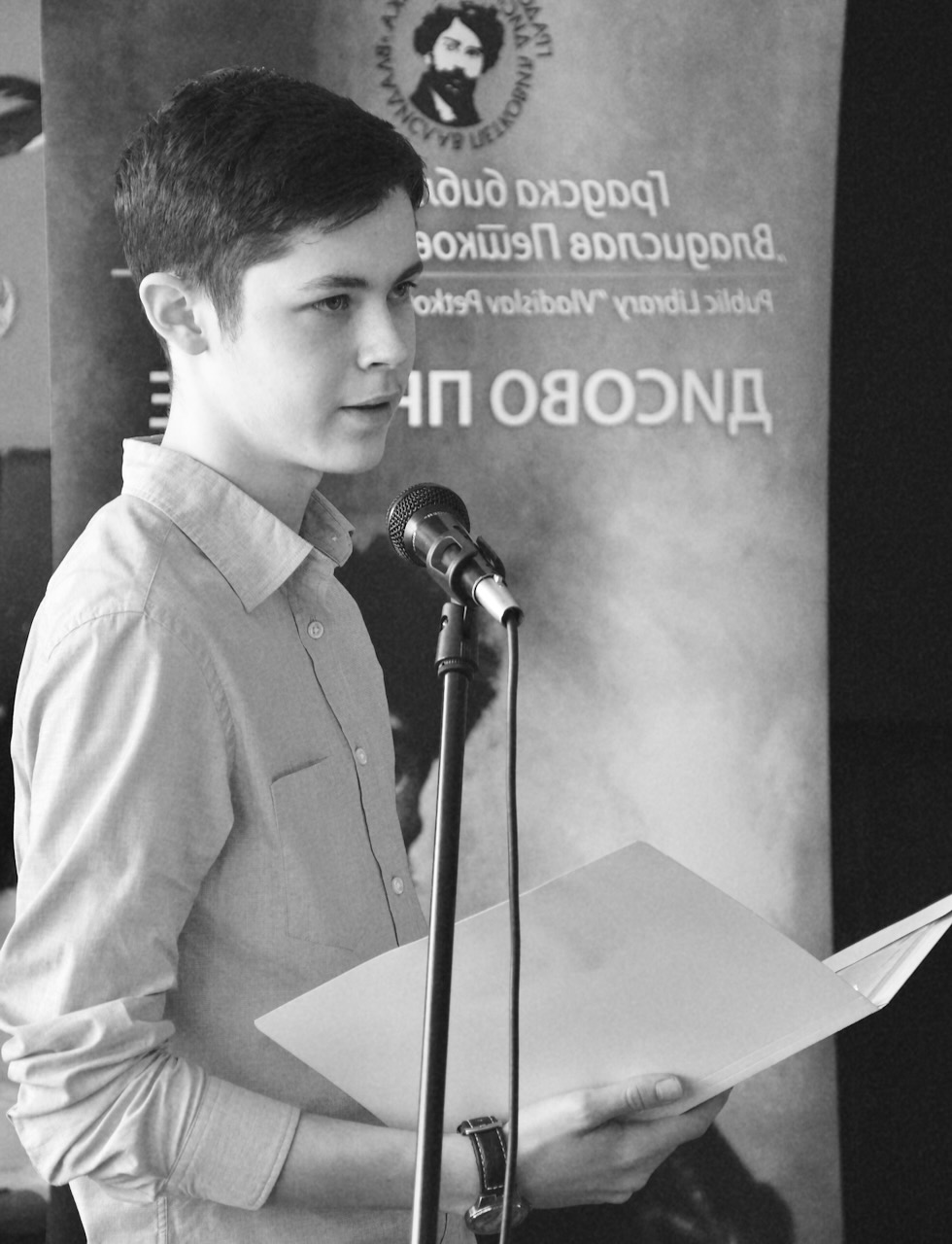
Photo courtesy of Čačak City Library Vladislav Petković Dis
Nicolas is a Serbian-American aspiring author and poet. Having lived in the United States and Canada for most of his early life, he writes primarily in his native language, English.
Greenwood’s first poems go back to his early teens, but most of his serious work has been written since he permanently relocated to Serbia at the age of 16. His poem Proleće has been translated into Serbian and featured several times before public audiences at events hosted by the City Library of Čačak.
When he’s not writing, Nicolas enjoys building and designing websites from scratch, studying typography, and exploring topics in the digital humanities. He lives in Novi Sad, Serbia, with his mother and twin sister.
You can learn more about him and follow his work by visiting his website: https://nicolasgreenwood.github.io